
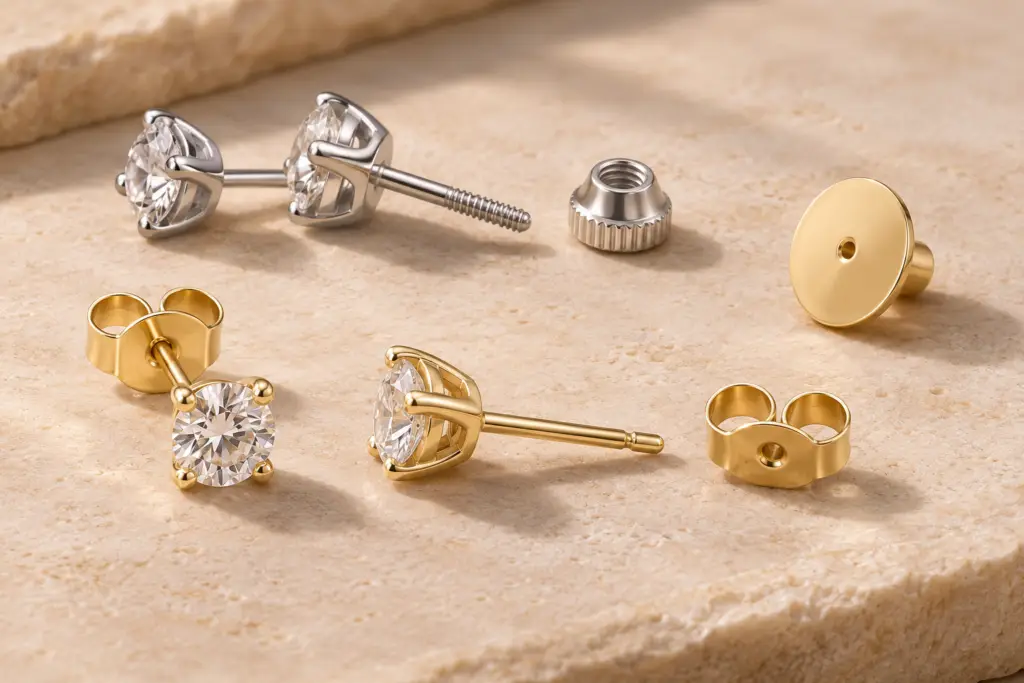
An earring’s front usually receives most of the design attention. Its shape, stones, and finish help define the collection. Yet customers also interact with the back every time they put the piece on or take it off.
Choosing earring backs belongs in the design conversation from the beginning. The right decision depends on the complete earring, how the closure works, and the experience your brand wants to offer. A familiar-looking component still needs review with the exact post and finished design.
1. Start with the way the earring will be worn
Are you developing small everyday studs, larger statement earrings, or a coordinated set with several sizes? Consider how the wearer will handle the piece. A tiny back may look discreet, but it should also be possible to hold it, locate the post, and remove it without unnecessary difficulty.
Use these observations to shape your brief. Avoid assuming that one closure will suit every design simply because it worked on an earlier collection.
2. Compare closure types in context
A push back slides onto a compatible post. A screw back uses a matching threaded system. Other locking systems may have their own release mechanisms and component requirements.
Rather than choosing from photographs alone, ask to see how the proposed system operates. Check whether the customer might need a short instruction and whether the back is easy to identify when removed. Review the actual components proposed for your order: a closure name alone does not establish performance.
3. Match the post and back
A post and back that appear similar to another set may not be interchangeable. Ask your manufacturer to confirm the combination, including post dimensions and component references. For threaded closures, confirm the matching parts together.
Review how the finished assembly engages, where it rests, and how it releases. If a component changes during development, revisit the combination before accepting the replacement.
4. Look at proportions from the side and back
Inspect how far the post extends, where the back sits, and how the finished earring rests during a fitting review. Consider whether the post position supports the intended orientation of the design.
For larger studs, compare backing options with the actual sample rather than selecting one solely because it looks more substantial in a catalogue. Comfort varies between wearers, so one person’s preference should not become a universal product claim.
5. Confirm each component’s material
Record the material and finish for the earring body, post, and back separately. If you offer multiple finishes, identify which back belongs with each version.
Confirm the final supplied specification before preparing product descriptions or care instructions. Avoid treating appearance as proof of composition or making claims such as “hypoallergenic” without appropriate evidence.
6. Review ordinary handling
Include putting on, removing, and storing the earrings in your sample review. Watch for points where the reviewer struggles to grip a component, understand the mechanism, or keep the pair together. Check both sides.
Discuss observations with your manufacturer and agree on any additional evaluation appropriate to the design. A brief handling review provides useful feedback, but does not establish long-term performance. If the closure or post changes, repeat the relevant review.
7. Plan for replacements and repeat orders
Keep the component reference alongside the earring’s style and variation details. Clarify whether spare backs are included, sold separately, or available by request. Confirm availability rather than promising it indefinitely.
Define the selling unit clearly: one earring, one pair, or a set. This helps align the product listing, order quantity, and accessories supplied.
Bring the back into the design brief
Choosing earring backs early gives your team time to compare options and resolve practical details while the design can still change.
At Bamina, we work with brands developing custom gold, sterling silver, and gold vermeil jewelry. When sharing an earring concept, include front and side references, intended dimensions, material preferences, and closure requirements.